
Produce sonido al aplicarle una tensión entre 1,5 y 6 Voltios.
Cuando se le aplica tensión, el oscilador genera una señal eléctrica que hace vibrar el material piezoeléctrico o magnético. Esto produce un tono fijo, sin necesidad de generar una señal desde un microcontrolador.
El positivo de las pilas se tiene que conectar al positivo (rojo) del zumbador.

¿Qué pasa si el terminal negativo de la pila se aplica por descuido al hilo rojo del zumbador?

Connecting the cable C to the point A, 1,5 V is applied to the buzzer and it sounds. Repeating the operation with the point Y, 6 V will be applied, and it will sound louder and higher pitched.

We have to be careful and connect the positive side of the buzzer (red) with the positive side of the battery (red).
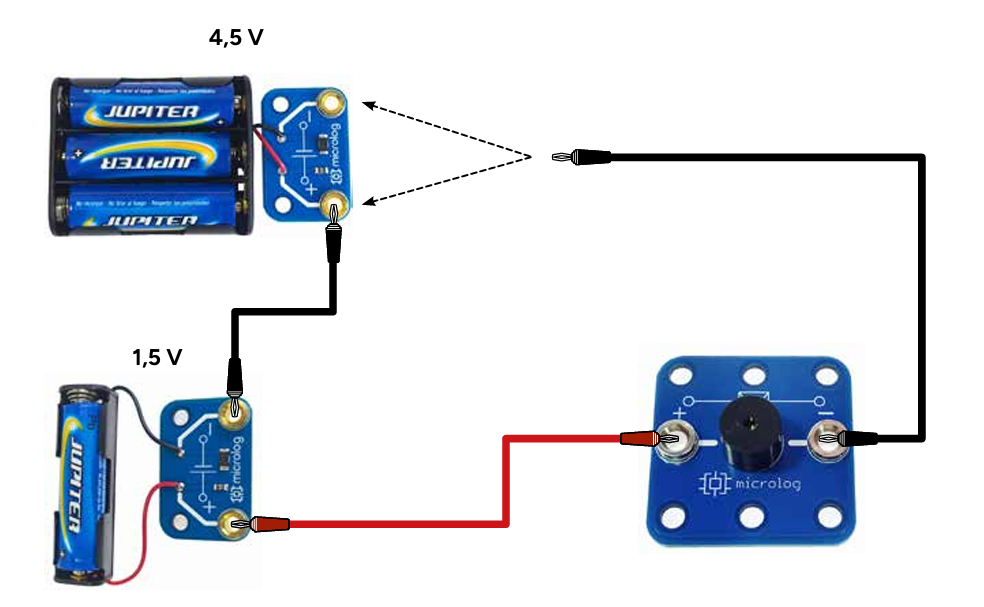
Se utilizan 2 portapilas, 1 minikit y 3 latiguillos de conexión.
Durante el tiempo que se esté presionando el pulsador P, la tensión V de la pila se aplica a la bombilla B y al zumbador Z en paralelo.

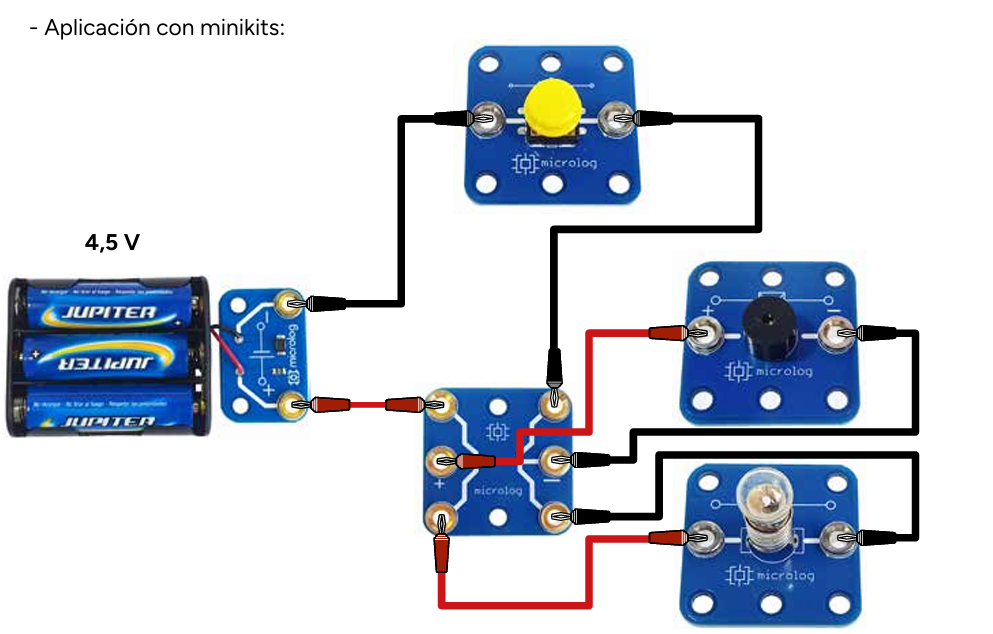

Se utilizan 1 portapilas, 4 minikits y 7 latiguillos de conexión.
El timbre solo funciona cuando la luz de “no molestar” está apagada.
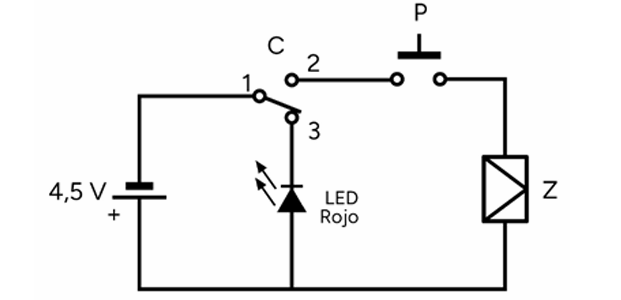
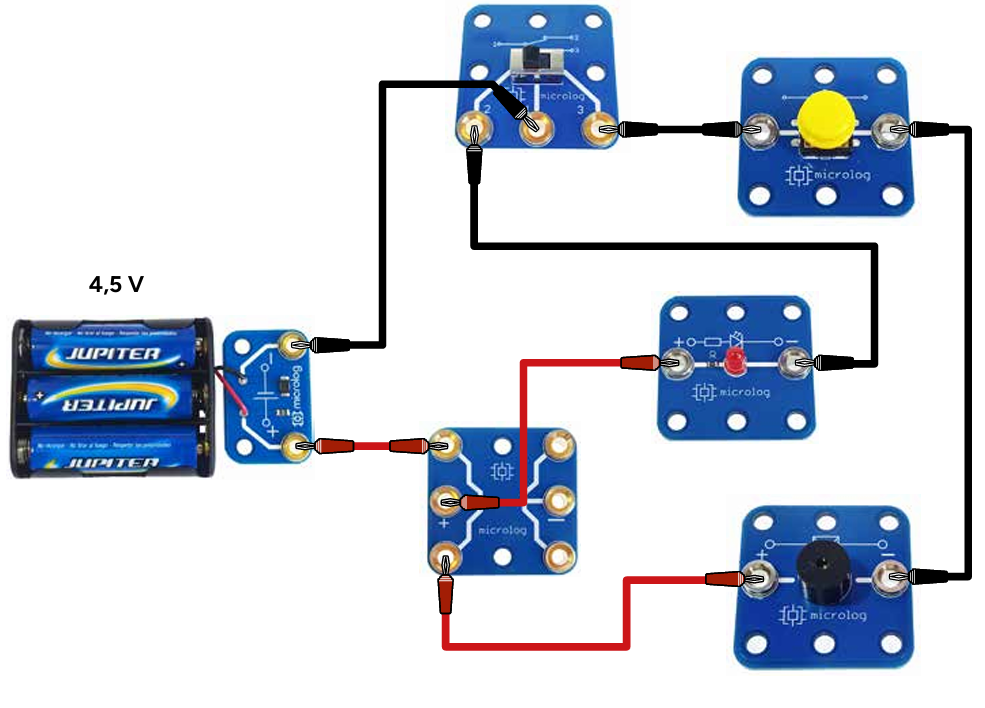
Se utilizan 1 portapilas, 4 minikits y 7 latiguillos de conexión.
 English (UK)
  Español